
Possible clues about the "destructive testing" Tyler Robinson's prosecutors want to perform.
Between the filings and the public comments at Tuesday's hearing, I have a guess about what's at stake.

Buried in the recent case filings about transparency are some hints about ongoing investigations and what’s at stake. And, reading between the lines, I now think I know what the destructive testing is about.
The court docket shows a defense motion filed on January 9th that has been classified as “private,” but the description of the motion is very general and gives no indication what it’s about. But from the motions litigating whether the motion should be sealed at all, some clues are given that suggest ongoing investigative steps by the prosecution.
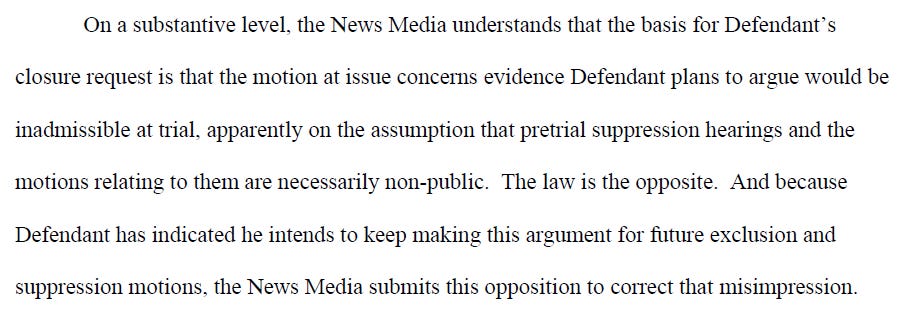
First, in its January 15th filing, the media indicates that the basis for the closure request is that the motion concerns evidence that might not ultimately be admissible at trial.
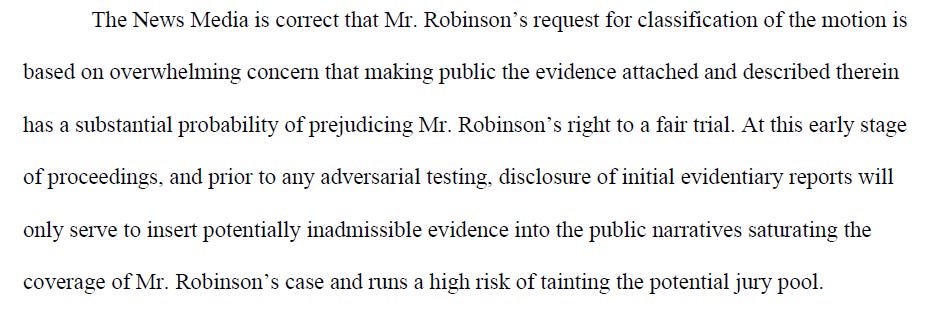
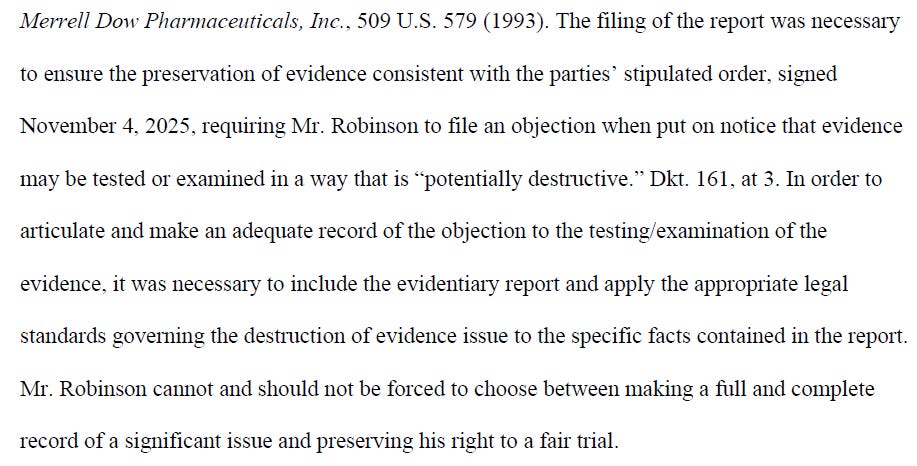
From the defense’s reply, we learn that the motion is supported by “initial evidentiary reports” and that the evidence at issue may not be admissible under the Utah Rules of Evidence for expert testimony as well as Daubert v. Merrell Dow Pharmaceuticals, Inc., a case that requires that scientific evidence meet minimum standards of reliability. And the defense informed us that the motion relates to potentially destructive testing to which the defense objects, which necessitated the motion in the first place.

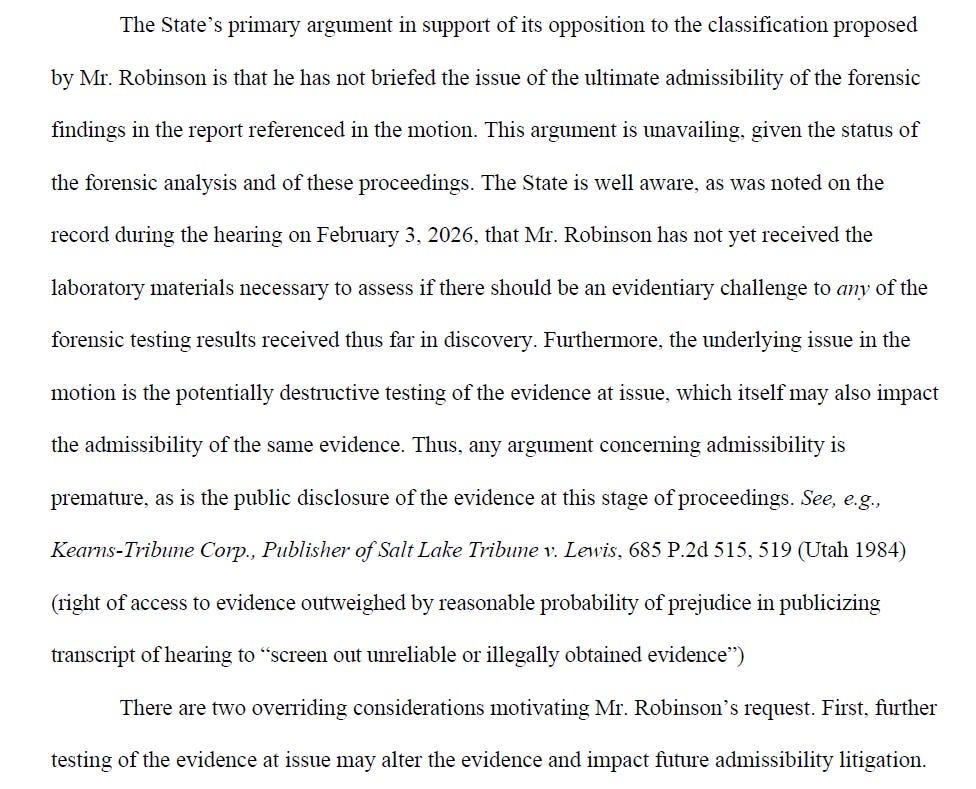
The State’s objection to sealing told us nothing new, but the defense’s reply to the State, filed on February 5th, certainly did. The defense refers to its comments during Tuesday’s hearing about not having yet received laboratory materials to assess the admissibility of the forensic evidence, and indicates that the evidence may be subject to “further testing” that is potentially destructive.
Recall, during Tuesday’s hearing when Judge Graf requested a discovery update, defense attorney Richard Novak specifically brought up “non-digital forensics,” specifically DNA analysis, for which the defense is still waiting for underlying data, bench notes, and similar items.
All of these references, taken together, imply to me that the destructive testing that’s at issue concerns DNA analysis. There are certainly other types of forensic analysis that produce reports and lab notes and that might be subject to a Daubert challenge - firearms analysis would be one potential example we’d expect in this case, both for any toolmark comparisons and for the operability of the firearm. But, unlike DNA analysis, I wouldn’t expect firearm examinations to rely on underlying data, or to generally involve destructive testing at all - even in Alec Baldwin’s case, where the FBI’s testing broke part of the gun, that result was inadvertent and not intended.
On the other hand, it isn’t uncommon for DNA testing to be “destructive” because the samples from which the DNA is obtained may contain only a small number of cells or genetic material to analyze. Still, accreditation standards - including those contained in the FBI’s Quality Assurance Standards (QAS) for Forensic DNA Testing Laboratories - require, whenever feasible, retaining a portion of a sample for retesting purposes.

This would also be consistent with the suggestion from the briefing that the State wants to do “further” testing on the “same” evidence that will be destructive - subjecting a retained sample or extract to retesting could consume what is left if the entire original sample contained only a limited amount of biological material to work with.
So if the “destructive testing” involves retesting the remaining portion of a DNA sample, what could that mean? I believe that Next Generation Sequencing is about to enter the case.
By far, the biggest revelation during Tuesday’s hearing was the defense’s suggestion that the DNA recovered from the scene contained a mixture from five different individuals:
This caught my attention immediately, because in standard STR analysis of DNA, a five-person mixture is considered extremely complex - beyond what many labs will even consider acceptable for interpretation. This is because random errors can be magnified and because alleles can (and do) overlap between contributors, so untangling who contributed what to the mixture becomes fraught with uncertainty when, as with STR analysis, only a small amount of genetic data is interpreted. Statistical tools like STRmix can generally handle some of these complexities, but the uncertainties involved significantly reduce the statistical strength of the conclusions - meaning, in short, that it isn’t very strong evidence, and the defense would likely have a lot more room to raise doubt about the State’s conclusion that Tyler Robinson was a contributor.
NextGen sequencing methods allow comparison of significantly greater amounts of genetic information, which makes it very useful for interpreting DNA mixtures. In the first case that allowed NextGen sequencing to be admitted as evidence trial - a California double murder case against Adrian Chavez - one of the reasons for using the technology was to help with deconvoluting DNA mixtures.
But, these techniques are still very new and largely untested in court. The prosecutor in Adrian Chavez’s case established the admissibility of the evidence following California’s equivalent of a Daubert hearing. Similar hearings have been held in Idaho and New York to address the scientific foundations and reliability of various NextGen techniques, but all of these cases have occurred within just the last couple of years and the technology is not yet in wide use or generally validated in courts.
Putting this together with the clues about the destructive testing the State wants to do in Tyler Robinson’s case, I think what the State is trying to do is perform additional testing on touch DNA samples from some item or items of evidence - whether the gun, the screwdriver, the towel, or some other piece of evidence “seized from the scene” as defense attorney Kathryn Nester put it. This explanation fits all of the clues - the defense would certainly want access to data and bench notes concerning a complex DNA mixture for review by its own experts of a conclusion that Tyler Robinson was a contributor; the State would be interested in retesting evidence that produced uncertain results using a more rigorous method that can potentially eliminate that uncertainty; the defense would prefer the State not potentially strengthen its DNA evidence with more robust technology that could eliminate uncertainties in an STR-only analysis, and so would be expected to object; the testing would certainly be subject to a Daubert-like defense motion and probable evidentiary hearing on reliability in Utah as a novel technology; and touch DNA samples tend to be limited in quantity, so there’s a good chance they don’t have a lot of genetic material to work with and retesting would consume what’s left of the sample.
Given Judge Graf’s propensity for letting the public watch the court work, I don’t imagine the January 9th motion is going to remain private for long. If I’m right, then we will have a front-row seat as the cutting edge of forensic science is litigated, and we’ll get a preview of the future of DNA analysis and everything it entails - the vast quantities of information now available, and the threat it poses to individual privacy. Tyler Robinson’s case is already high-profile, but if NextGen sequencing is the destructive testing at issue, it’s about to become constitutionally important as well.
Off topic but any chance you'll consider covering this Faust case in the state of Georgia? It's running live now, so we'd have to catch up but it sounds like it needs some very bright lights upon it.
I find the "Merrell Dow Pharmaceuticals" part interesting! I've studied many dozens of "shooters", like in schools, etc. and when I can find the information, they have ALL been on SSRI drugs, or some other form of Psych Meds. Merrell Dow Pharmaceuticals makes "Flupentixol" and it's an antipsychotic that acts on dopamine receptors, used for managing chronic schizophrenia and depressive symptoms. The way doctors doll out this crap, it's a wonder we don't have more of these events :(